
The new targets are now all available at the Hangout.Audio Graph Comparison Tools!
Hello, and welcome back to this woefully neglected corner of the internet once again. Feels good to be writing an article after what seems like forever… so let’s just jump right in.
Table of Contents

Red: IEF Preference 2025; Grey: IEF Neutral 2023
IEC 60318-4 “711” Coupler
In case you don’t want to read the rest of this article
The History of IEF Targets
First, if you would indulge me, let’s talk about the evolution of it all.
We first had the original Crinacle Target, created at the beginning of 2019 that was essentially just me attempting to will a target curve into existence based on vibes (read: “subjective experiences”). It’s fun to look back on this era where we were all basically fumbling around in the dark looking for a viable alternative to the absolutely terrible Harman IE 2017 target, and in hindsight I may have Lorho’d it a bit too far.

Then, after denouncing the original Crinacle Target, we have the IEF Neutral Target. Back then it was just simply “IEF Neutral”, no “2020” suffix just yet, and… there’s not too much in terms of changes. The ear gain around 3kHz was increased as subjectively I felt that the old Crinacle Target was subjectively too muffled in the upper mids, and brought the target just a wee bit closer to traditional Diffuse Field. A much needed change and for 3 years, we saw many brands and manufacturers vying to hit this target with varying levels of bass emphasis.
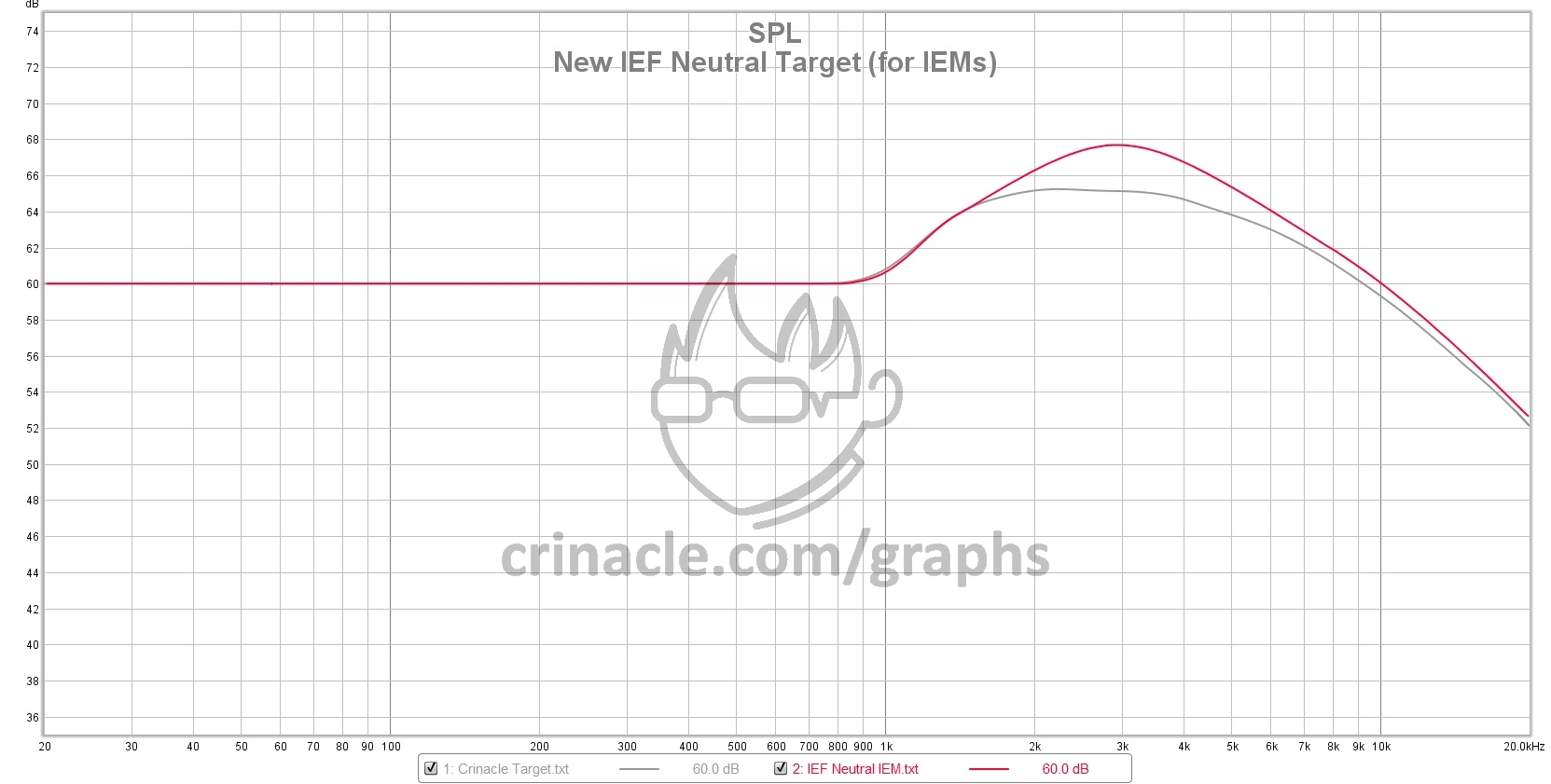
More recently (and by recent I mean two years ago; how can this be two years ago?!), we have IEF Neutral… this time wearing 2023 garb. IEF Neutral 2023 was the most significant update to the target at the time, being based on an extrapolation of -0.8dB/oct tilted Diffuse Field on the (then brand new) B&K Type 5128 to the IEC 60318-4 system, slightly modified at 400Hz and 3000Hz, with treble regions largely untouched due to high uncertainty in those areas.

Subjectively, this is a very nice change. The two main areas of modification were in the lower frequencies as well as around the 1500Hz region; the lift in the lower mids (roughly 2-3dBs) gave much-needed weight and heft to the notes, while the suppression between 1kHz and 2kHz resulted in reduction in honkiness and improved timbral accuracy.
But now you’ve probably realised that this is a progression of the “Neutral” curve. Instead, now I would like to present to you the IEF Preference curve (2025 edition), a target curve created not in the pursuit of perceived neutrality, but rather what simply sounds… nice. To me.
The Baseline
First, we’ll need to address the big mannequin-shaped elephant in the room.
The B&K Type 5128 is the newest kid on the block, and compared to the 711 coupler which has seen 50 years in service so far, adoption of the new standard hasn’t been as prolific as I’d had hoped. That said, it is still the most accurate head and torso simulator (HATS) that we have for now, and so it remains as gold standard for IEM measurements going forward… for now at least.
For every HATS, the default baseline (i.e. “flat”) is typically its Diffuse Field response. To put it simply, Diffuse Field is when you put the HATS in a highly reverberant room with flat omnidirectional speakers, and then measure the response at the “eardum” of the HATS.
In the case of the B&K Type 5128 mannequin, what you get is this:

The “5128-DF” Target on the Hangout.Audio Graph Comparison Tool
Now normally we would just use this as a baseline and call it a day, but recent findings have shown that the B&K Type 5128’s pinna flange seem to overestimate treble response relative to the average human’s.
I won’t go into the weeds of all of this as Listener from Headphones.com have already done a bang-up job explaining all of this, so the TL;DR is this: in lieu of the Diffuse Field response that is specific only to the ear of the B&K Type 5128, Joel Merrifield created a new Diffuse Field target using mathematical weighting between the response of the 5128’s ear canal and the response of the average human’s outer ear under ISO 11904:1.

This is the JM-1 Diffuse Field target, marked as “PopAvg-DF (JM-1)” on the Graph Tool in reference to the fact that it’s a “population averaged” (ISO 11904 outer ear) Diffuse Field response as opposed to one that is specific to the B&K Type 5128 mannequin (5128-DF).
In theory, this new DF target should be more representative of “flat” for more people, compared to 5128-DF that seems to be on the higher end of deviation in the upper frequencies. As such, this is also the default DF baseline that is shown on the Hangout.Audio 5128 Graph Tool, but you still have the option to use 5128-DF if you really want to.
(All this is only relevant for IEMs. For headphones, we ideally still want to use 5128-DF as headphones interact with the pinna flange.)
Now that we have our baseline sorted we would now recommend users to modify the baseline to their taste, whether by using tilt, bass, or treble adjustments.
The question now of course is, what combination exactly sounds the best?
Tilt versus Treble
In the case of tilting versus treble adjustment, they both achieve similar results in different ways.
For the treble adjustment, the Hangout.Audio Graph Tools use the same parameters that were used in the Harman 2015 studies: a high shelf filter (HSQ) at 2500Hz with a Q-factor of roughly 0.4. This creates a high shelf that begins at roughly 500Hz, with everything under being unaffected by the filter.
Contrast this with a tilt, wherein (usually) the entire spectrum from 20Hz to 20,000Hz is shifted up or down per octave. So for instance, a -1dB/octave tilt means that the curve is tilted -1dB for every doubling in frequency.
40Hz is -1dB relative to 20Hz, 80Hz is -1dB relative to 40Hz, 160Hz is -1dB relative to 80Hz… so by the time we hit 20,000Hz, it should be about -10dB relative to 20Hz. This is why a -1dB/oct tilt is also sometimes referred as a “10dB slope”, referencing the dB difference between 20 and 20,000Hz instead.
Like I’ve said before, they achieve similar results in different ways, but the way the results differ are important in how I would determine the ideal “preference curve”, at least for myself.
My new rule of thumb is simple: tilt is best on its own, treble should be adjusted in tandem with bass, but tilt adjustments do not sound as nice with bass adjustments (to my ears).
The premise is simple: a full tilt works on its own precisely because it affects the entire spectrum, inclusive of the bass. A -1dB/oct tilt is pleasant for me, perhaps a little light on the bass for my purest enjoyment, but a tuning that works for most and serves as a good reference point for what is a “balanced” sound signature.

The Truthear Hexa is currently the closest IEM to JM-1 with a -1dB/oct tilt, but is still often criticised for its lacklustre bass response.
However, trying to add on an additional bass shelf on top of tilted JM-1 results in the bass muddying up very quickly, whether in terms of texturing or simply having the low frequencies intruding into the melodic frequencies.
This is because the tilt filter also results in the lower mids (200-800Hz) rising relative to the upper mids, making the mids in general even more sensitive to any additional changes to the bass response. Even a small boost can result in bloating, which can sound worse than original “bass deficient” response.
Instead, what I had found worked best was to use a high shelf filter whenever a bass boost is required. The lower mids remain relatively untouched, allowing for more emphasis in the lower frequencies without muddying up the sound. The number that I had personally landed on is a -4dB high shelf (2500Hz, 0.4Q) which provides an ideal canvas for me to slap the bass on, but the number would definitely vary depending on your own subjective experiences.

So with the higher frequencies settled, we can finally move on to the bass response, right? But now we run into another unexpected problem…
The Bass Dilemma

This is the “standard” bass shelf. 105Hz with a Q-factor of 0.71, this is the low shelf filter that respondents were allowed to adjust in the very important, very prolific Harman 2015 studies.
And because of that, it has become the bass shelf, the default value that everyone ends up using for their own EQ adjustments. And for the most part, it works.
But (in my opinion) it’s not quite as ideal on the 5128. Especially with Diffuse Field as a baseline.
Even when used in tandem with a high shelf instead of a tilt, adding a low shelf centred at 105Hz still introduces in a bit of additional poofiness and bloat in the lower frequencies. Not nearly as bad as with tilt+bass, but still enough that it bothers me personally.
After a lot of experimentation (both with EQ and prototyping of actual physical IEMs), I found that adjusting the “standard” low shelf filter from 105Hz down to 80Hz (keeping the 0.71 Q-factor) resulted in the best balance between retaining bass impact without causing bloating or mud. Now, that may not seem like a big change (“it’s just 25Hz!” you may cry) but what it results in is this:

+10dB may seem like a lot, but remember, we’re pairing this with a high shelf filter, not a tilt. I don’t need the extra midbass, but I definitely need the extra sub (speaker boys can attest). At any case this is my preference and I like this amount of (sub)bass, so I don’t have to justify this beyond a simple “this sounds good to me”.
And for those who want less bass or more midbass, well… that’s the beauty of adjustable targets.
So there we have it, IEF Preference 2025 for the 5128: PopAvg-DF (JM-1) with a -4dB high shelf and an adjusted 80Hz low shelf set to +10dB. Feel free to try it out for yourself at the Hangout.Audio 5128 Graph Comparison Tool, and you still have the freedom to adjust the PopAvg-DF target as you see fit.
But for those who would like to use the new IEF Preference curve on 711 measurements, you still can… but there are some caveats.
711 Targets?
Before we can start doing anything, we first have to transpose PopAvg-DF (JM-1) that was originally meant for the B&K Type 5128, onto your bog-standard IEC 60318-4 coupler.
It’s a tedious operation, basically taking the measured differences of the same IEM between the B&K Type 5128 and a 711 coupler, doing it a few times for different IEMs, averaging out all the deltas (differences) and smoothing the ever-living daylights out of it. And with this calculated delta you can now apply it to get the JM-1 Diffuse Field curve, translated for the 711 coupler.

This is referred to as a “delta” target because it is created by extrapolating the deltas between measured responses from the B&K Type 5128 rig, and the more traditionally available 711 coupler. Credit once again to Listener for his work in calculating the deltas to create the PopAvg-DF JM-1 Delta target.
However, it has to be said that is not a foolproof method to get a “5128 target” onto a 711 coupler. It is a big leap forward for 711 measurbators, no doubt, but it doesn’t mean that a 711 with a delta target is a slot-in replacement for an actual B&K Type 5128, no. The actual, physical acoustic impedance of the measurement rig still matters a lot, and in many cases the same IEM measured on both the 5128 and 711 can still have different deltas between the two.

A good example that I always like to show is the delta between the original Moondrop Blessing and the Blessing 3; the former being an IEM that I had constantly mentioned having absolutely terrible bass despite being a hybrid. And yet, when measured on a 711 coupler, the original Blessing actually measures with more bass (normalised at 1kHz), which has led to some calling me a filthy subjectivist for daring to speak out against the squiggly lines.
However, things take a 180 turn when both are measured on the B&K Type 5128:

All of a sudden, the narrative is different. The Blessing 3 now measures with significantly more bass (more than 5dBs!) and is far more inline with my subjective impressions than the 711 data.
Remember: these are the exact same IEMs, measured on the same B&K Type 5128 and 711 coupler, using the “same” PopAvg-DF JM-1 Target. And yet, the deltas are completely different (in the bass response) which shows that even when a delta target is used on the 711, the data can still be inaccurate relative to actual 5128 measurements.
And while this discrepancy in deltas is more common in the lower frequencies, they can encompass higher frequencies as well:

This a Project Daybreak, a prototype of a yet-unreleased IEM designed with one goal in mind: to hit IEF Preference 2025 as closely as possible on the B&K Type 5128. And in terms of the prototype samples, I do believe that we have achieved that goal.
However, a measurement on the 711 coupler doesn’t quite tell the same story:

It’s not completely out of spec, but clearly it’s not as adherent to PopAvg-DF JM-1 with -4dB treble adjustment as it was when measured on the 5128. And believe me; we have the means to have Project Daybreak hit JM-1 Delta more closely on the 711, but at that point it’s more out of spec on the 5128.
And quite frankly, it sounds the best as it is right now. Soon™.
IEF Preference 2025 (IEC 711)
Now we’re finally at the point where we can determine what is IEF Preference 2025 for the 711 coupler. To do so, it is best to use a common reference point between the two rigs, and one that is ideally as close as possible to the target on 5128.
So what better candidate than Project Meta.

Repeating again, IEF Preference 2025 on the B&K 5128 uses the PopAvg-DF JM-1 target as a baseline, and adds a -4dB treble adjustment as well as a modified 80Hz low shelf set at +10dB.
So now it makes sense to apply the same parameters to the JM-1 Delta target for the 711 (with the bass boost modified to +8.5dB to match response at 20Hz), and we’ll see Project Meta hit near-perfect target compliancy on the 711 coupler, right? Well…

Not quite.
Now we see Project Meta overshooting the 50-400Hz region, despite having nearly same parameters on the 5128 being applied to the delta target. We even matched the response at 20Hz to give us the best chance! What gives?
I’ll provide some theories on why that is further on, but here’s the really interesting thing: what was a 80Hz low shelf on the 5128’s JM-1, is now equivalent to the standard 105Hz low shelf on the 711’s JM-1 Delta.

Yep, that is IEF Preference 2025 for the 711. The same -4dB treble adjustment on JM-1 Delta… but with a +8dB “standard” bass shelf. We’re seemingly back to square one for some reason.
⚠️⚠️ Nerd Talk Warning ⚠️⚠️
Our strongest theory for this discrepancy is that different types of woofers result in different deltas between the 5128 and 711; just like in the Moondrop Blessing and Blessing 3 example, you could have an IEM that measures with a decent amount of bass on 711, but then said bass levels fall off when measured on a 5128.
As such, when you mix in IEMs with good leakage tolerances (i.e. Blessing 3) and IEMs with bad leakage tolerances (i.e. original Blessing) in the 5128-711 delta calculation, what we may end up with is a delta that underestimates the bass difference on an IEM with good leakage tolerance, and as such requires a higher-frequency bass shelf to compensate.
The implication of this is that there may be a need to have separate delta curves for different IEM categories, for instance a delta curve for “good bass” IEMs (DD woofers, vented BA woofers etc.) and a delta curve for “bad bass” IEMs (unvented BA woofers, high stiffness diaphragms etc.), but that’s a topic for a different time. Either that or you just measure on a 5128 and save yourself the headache.
For the rest of you mid-tier nerds just wanting a decent preference curve for my 711 measurements, here it is. At least until the inevitable next iteration.

Conclusion & Caveats
Here is where I’ll have to emphasise that the IEF Preference 2025 curve is not the “perfect” tuning. It is not a target that will absolutely sound the best to everybody; even the Harman 2015 study establishes that there is a wide range of treble/bass adjustments that everyone prefers individually.
What IEF Preference 2025 represents is simply the bass and treble adjustments that I, Crinacle, personally like in an IEM. I have my reasons and justifications, of which this article plainly lays out for your perusal, but at the end of the day I still encourage you to do the legwork to find your own ideal target curve. Play around with tilts, mess with the bass and treble– the Hangout.Audio Graph Tools are built with powerful functions that allow you to do so.
But for the lazy… hey, here’s a new target you can sniff graphs with.



18 thoughts on “The New 2025 IEF Target”
Obligatory “my IEM+EQ profile just started sounding 5 times better” comment 🙂
“I’VE PLAYED THESE GAMES BEFORE!!! I SAID I’VE PLAYED THESE GAMES BEFORE!!!”
Bro came back
Hey Crin, I think the treble adjustment in the tool is adding dbs to the mids and below. It doesn’t seem to act for me like it does in your screenshot
>the treble adjustment in the tool is adding dbs to the mids and below
it just adds some make-up gain to the highshelf filter
I’ve EQ-d my S12PRO to a meta target and I like it a lot applied at my Hiby R6III 🥇
Def gonna keep it!🔥
Lesssssssgo
does anyone know if this will be sub $300 iem?
everybody:
“Project Daybreak” (the prototype IEM designed to hit IEF Preference 2025) has been officially released as the CrinEar Daybreak, and it currently retails for $169.99
I really appreciate your knowledge and effort!
I stumbled across this page by accident and it has been extremely helpful to me.
It’s like the fog has lifted from my head (although the fog about the target curve is likely to never go away).
Personally, your written content is peak; and if you ever release any more article, I will be in the front seat
Thank you very much, Crin, for explaining this, and especially your clarity in discussing the JM-1 curve. Despite Listener’s and JM’s verbosity, this succinct article is the one that helped me understand it.
A question for you though: what would the FR of flat studio monitors in a properly treated room (studio, basically) look like with the 5128 rig? Having that tonality in an IEM would be great: one reference set in a collection.
My thoughts on the 50-400Hz discrepancy
I think is more on the crossover, as if there’s a question of leakage, look no further than the infra-sub response, basically below 40Hz you’ll see the response start to drop, usually below 20Hz or the response drops below 15Hz on a standard 10mm DD. if there’s leakage issue, its the lower subbass and infra that suffers first. the 100-200Hz crossover region is where there’s a change in response, and I’ve seen lots of sets on your database between the 2 rigs, there’s always been a different behaviour in the bass crossover region between both graphs which makes me strongly believe its the bass response estimation is generally different between the 2 rigs, lets say the 5128 is more sensitive there i suppose…
On the bass shelf + treble shelf vs. bass shelf + tilt dilemma.
You can always approximate one with the other.
e.g.Rtings 4.3dB 105Hz Q0.7 + -0.6dB/oct is the original target.
6.8dB 105Hz Q0.6 + -3dB 2500Hz Q0.4 is perfectly covers it, between 20 and 18kHz the delta is less than 0.2dB.
You can approximate this 10dB 80Hz Q0.7 + -4dB 2500Hz Q0.4with the following, with 0.3dB precision troughout the whole 20-20kHz range:
7dB 80Hz Q0.8 + -0.7dB/oct
*edit: 7.1dB instead of 7 in the last line
Bro when you come back children hungry
can we download and open in REW for ab?